
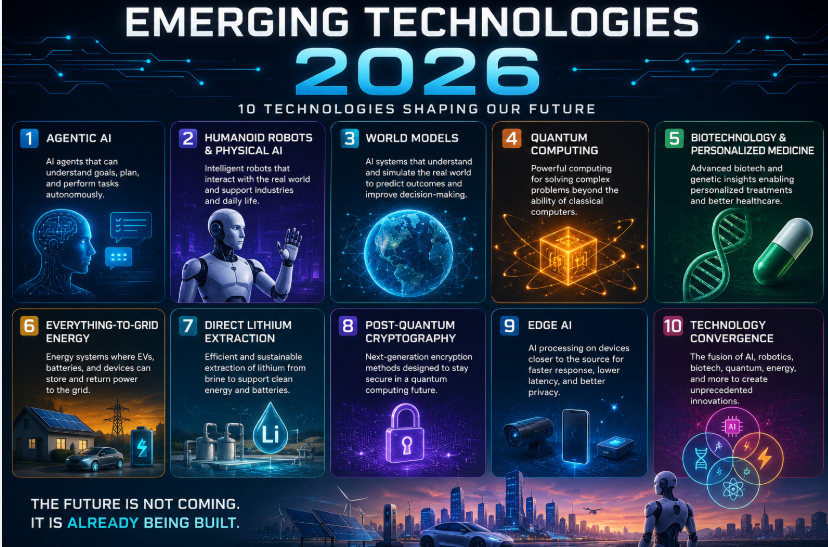
Emerging Technologies 2026: Technologies Shaping Our Future
Technology is changing faster than ever. Every year, new innovations transform the way we work, communicate, learn, travel, and live. In 2026, several emerging technologies are becoming more powerful and practical, creating new opportunities for businesses, researchers, and everyday users.
From Artificial Intelligence to robotics, quantum computing, biotechnology, and advanced energy systems, these technologies could have a major impact on our future.
1. Agentic AI
Artificial Intelligence has already become a part of our daily lives. But in 2026, Agentic AI is becoming one of the most exciting developments.
Unlike traditional AI, which mainly responds to instructions, AI agents can understand a goal, plan multiple steps, and perform tasks with less human intervention.
For example, an AI agent could analyze data, prepare a report, manage customer support, or complete routine business tasks automatically.
2. Humanoid Robots and Physical AI
AI is no longer limited to computers and smartphones. It is now moving into the physical world through robotics and Physical AI.
Humanoid robots are being developed to work in factories, warehouses, healthcare facilities, and other environments. With advanced sensors, computer vision, and AI, robots can understand their surroundings and perform increasingly complex tasks.
In the future, robots may become an important part of both workplaces and everyday life.
3. World Models
Another emerging technology is World Models.
World models help AI understand how the real world works. Instead of simply recognizing information, these systems can learn relationships between objects, actions, and events.
This technology could be particularly useful for autonomous vehicles, robotics, simulations, and intelligent systems that need to predict what might happen next.
4. Quantum Computing
Quantum Computing is another technology with enormous future potential.
Unlike traditional computers, quantum computers use quantum principles to process certain types of problems in fundamentally different ways.
Potential applications include drug discovery, materials science, optimization, climate research, and cryptography.
Although large-scale practical quantum computing is still developing, 2026 is an important year for continued research and progress in this field.
5. Biotechnology and Personalized Medicine
Technology is also transforming healthcare.
Biotechnology is helping scientists develop more personalized treatments based on an individual’s genetic information and specific medical conditions.
Personalized medicine, advanced gene technologies, and customized cancer treatments could make healthcare more precise and effective in the future.
The goal is simple: instead of giving the same treatment to everyone, doctors may increasingly choose treatments based on the unique characteristics of each patient.
6. Everything-to-Grid Energy
The energy sector is also experiencing major technological changes.
Everything-to-Grid systems can allow electric vehicles, batteries, and other energy-storage devices to interact with the electricity grid.
For example, an electric vehicle could store electricity and potentially send power back to the grid when needed.
This could help create a more flexible and efficient energy system while supporting the growth of renewable energy.
7. Direct Lithium Extraction
Lithium is an important material for batteries used in electric vehicles and energy-storage systems.
Direct Lithium Extraction (DLE) is an emerging technology designed to extract lithium from brine more efficiently.
As demand for electric vehicles and batteries continues to grow, technologies that improve lithium production could become increasingly important.
8. Post-Quantum Cryptography
As quantum computing develops, cybersecurity will become even more important.
Some existing encryption methods could eventually become vulnerable to powerful quantum computers. Post-Quantum Cryptography (PQC) aims to develop encryption methods that can remain secure in a future where quantum computers are more powerful.
This technology could help protect financial information, government systems, business data, and personal communications.
9. Edge AI
Most AI applications depend heavily on cloud computing. But Edge AI brings AI processing closer to the device where the data is generated.
For example, smartphones, cameras, vehicles, industrial machines, and IoT devices can process information locally.
This can provide faster responses, reduce dependence on internet connectivity, and potentially improve privacy.
10. Technology Convergence
Perhaps the biggest technology trend of 2026 is convergence.
Different technologies are increasingly working together.
For example:
- AI + Robotics
- AI + Biotechnology
- Quantum Computing + AI
- Advanced Materials + Energy
- AI + Cybersecurity
When these technologies combine, they can create solutions that would not be possible with a single technology alone.
Why Emerging Technologies Matter
Emerging technologies can create enormous opportunities, but they also bring challenges.
Businesses will need to adapt to new technologies. Workers will need to develop new skills. Governments and organizations will need to think about privacy, cybersecurity, ethics, and responsible innovation.
For individuals, one of the most important skills will be continuous learning.
The technology landscape will continue to change, so learning new tools and understanding how technology works will become increasingly valuable.
Conclusion
Emerging Technologies 2026 show us that the future is being built right now.
Artificial Intelligence, robotics, quantum computing, biotechnology, advanced energy, and cybersecurity are moving forward rapidly. These technologies could change industries, create new jobs, improve healthcare, and solve some of the world’s biggest challenges.
The future will not belong only to those who create new technology. It will also belong to those who understand it, adapt to it, and use it responsibly.
The future is not coming—it is already being built. And 2026 is helping shape what comes next.